Cambodia has its own currency, the riel, but walk into a supermarket in Phnom Penh and most of the prices you see will be in US dollars. Both currencies are used at the same time, often in the same purchase. Here is how that works in practice, so you know what to hand over and what to expect back.
Most shop prices are in US dollars
In supermarkets, convenience stores and electronics shops, the shelf price is usually written in dollars with a $ sign: $8.00 for a bottle of soy sauce, $1.77 for a cup of noodles. You can pay these with US dollar notes, and you do not need to change money into riel first just to go shopping.
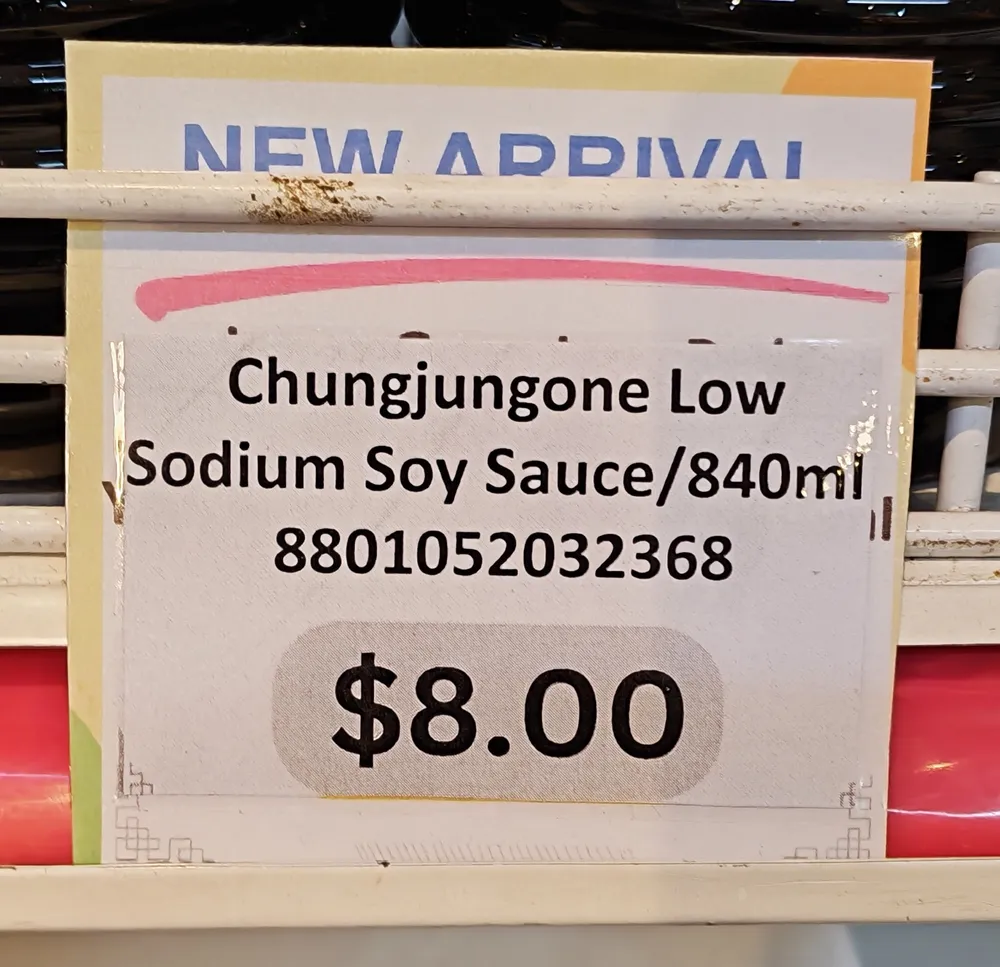
The tag above is typical: the product name, the barcode and one price in dollars. Nothing on it mentions riel, yet you are in a country whose official currency is the riel.
Many tags show riel too
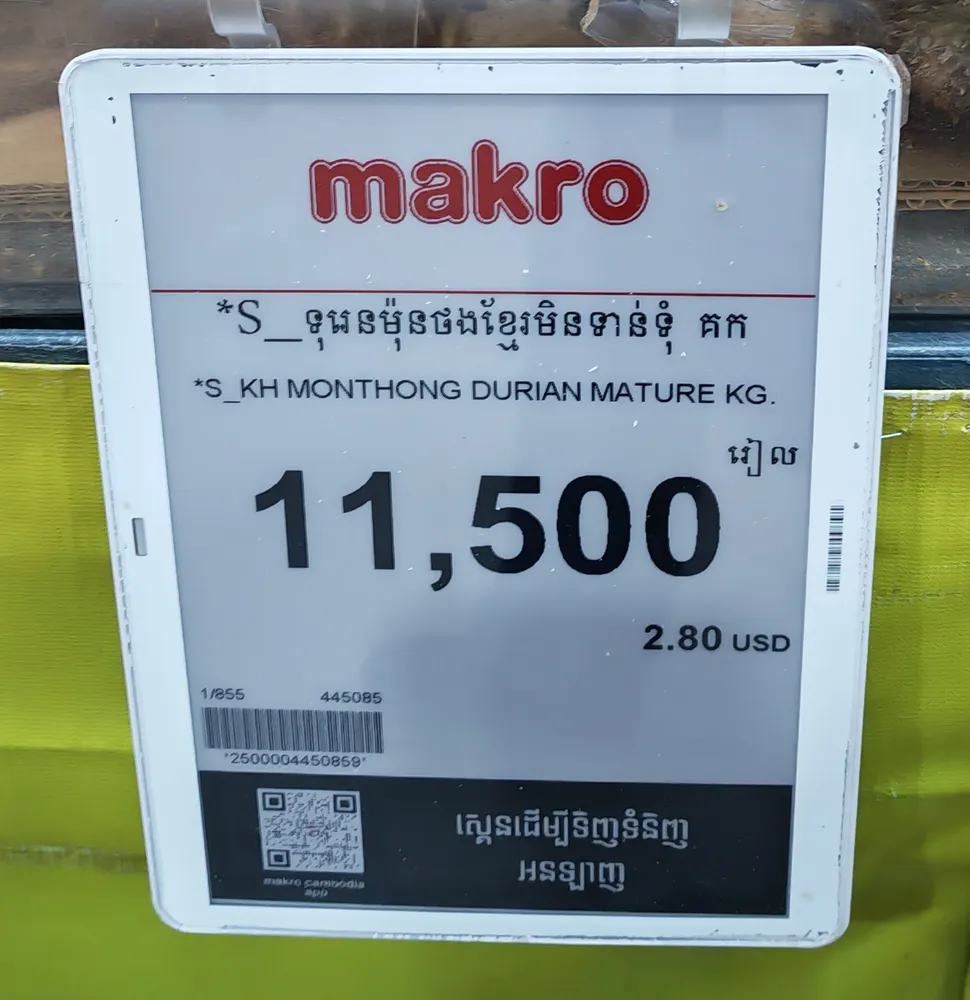
Plenty of tags give both currencies. Supermarket electronic labels and electronics-shop tags often print a large riel amount with the dollar amount next to it or underneath. On the label below, the big number is riel and the small line underneath is the same price in dollars.
You will recognise riel amounts by:
- the symbol
៛or the codeKHRnext to the number; - the Khmer word for riel, រៀល, printed beside it (as on the label above);
- the size of the number: riel amounts run into thousands for everyday items (
11,500) and into hundreds of thousands or millions for appliances (1,089,500).
Riel prices are written with commas between the thousands, like dollar prices in English, and they have no cents. In practice they are always a multiple of 100, because riel is paid in notes and the smallest note in everyday use is 100 riel.
When a tag shows both, the two amounts are the same price, so you can pay whichever way you like. On the label above, 11,500 riel and 2.80 dollars agree at a bit over 4,000 riel to the dollar.
Change under a dollar comes back in riel
Dollars change hands as notes. When your change includes cents, the part under a dollar is usually given in riel. Pay for a $1.50 item with a $2 note, for example, and you should get back about 2,000 riel rather than 50 cents.
That means you will collect riel notes even if you never change any money. They are perfectly good for paying: use them for small purchases, or hand them over together with dollars to make up an amount.
Notes, not coins
Riel is paper money: in shops you will be given notes, not coins, and the smallest note you will commonly see is 100 riel. Small riel notes add up quickly in a wallet, so it is worth spending them on snacks, drinks and other small items as you go.
How many riel to the dollar?
Roughly 4,000 riel make one US dollar. The tags photographed for these guides match that: the Makro label above works out at a bit over 4,000 riel per dollar, and an electronics-shop tag pricing a printer at 1,089,500 riel or $269.00 works out at about 4,050. Shops round to their own figure, so do not expect every tag or every till to use exactly the same rate.
Some handy reference points at about 4,000 to the dollar:
- 1,000 riel is about 25 US cents;
- 2,000 riel is about 50 cents;
- 4,000 riel is about one dollar;
- 10,000 riel is about 2.50 dollars;
- 40,000 riel is about 10 dollars.
The rate does change over time. For today's figure, and a table of common amounts, see the riel to US dollar converter.
Practical tips
- Bring some small US dollar notes. Since change under a dollar comes back in riel, paying close to the exact amount keeps things simple.
- When a tag shows two prices, check whether they are the same price in two currencies or two different prices. On electronics tags a red promotion tag in both currencies can sit over an older dollar price; the guide to Cambodian price tags shows how to tell them apart.
- If a price is only in riel, divide by about 4,000 for a quick dollar figure, then check the converter if the amount is large.
How GlotLens helps
GlotLens reads the price tag for you when you point your phone's camera at it. On Cambodian tags it reads dollar prices ($ and USD) and riel prices (KHR and ៛), and when a promotion tag gives the same price in riel and in dollars, it takes that matching dollar amount as the price to pay rather than the older price beside it. It then converts that price into your own currency, so you do not have to do the 4,000-riel arithmetic in your head, and lets you add what you buy to its expense ledger. Download GlotLens before your trip.