
Cambodian price tags mix two currencies, US dollars and riel, and several layouts. Most are easy once you have seen them, but a few can trip you up: a promotion tag stuck over an older price, a fruit label that is really a price per kilo, or a price with no cents. Here are the common kinds, with real tags photographed in Phnom Penh shops.
Plain dollar tags
The simplest tag gives one price in US dollars. Supermarkets that sell imported goods often print tags with the product name, size, barcode and a single dollar price, such as $8.00 for an 840 ml bottle of soy sauce. That amount is what you pay.
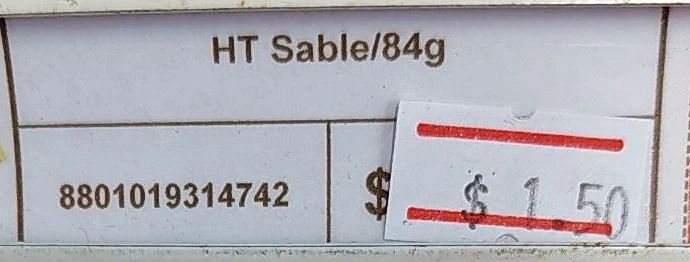
On printed shelf strips the $ sign is sometimes in its own box, set apart from the amount: you see $ and then, a little further along, 1.77. They still belong together; the number is a dollar price.
Price stickers on the tag
Shops also put small price stickers on top of the printed tag, as in the photo above. The sticker carries the amount (here $1.50) and sits in the price box next to the printed $. Despite the red lines across it, the sticker's $1.50 is the price of this item. When a sticker is half hidden behind the shelf rail, look at it from a different angle before you take the number at face value.
Tags with dollars and riel
Many tags show the same price twice, once in riel and once in dollars. Riel amounts are the big numbers with thousands separators (11,500, 1,089,500), often marked KHR, ៛ or the Khmer word រៀល; dollar amounts have a $ or USD and usually two decimals. The two amounts agree at roughly 4,000 riel to the dollar, so you can pay in either. If you are unsure which is which, see Dollars or riel? Paying in Cambodia's shops.
Electronics shops: the promotion tag wins
Electronics shops often lay a coloured promotion tag over the regular shelf tag. Here is a printer at an electronics shop in Phnom Penh:
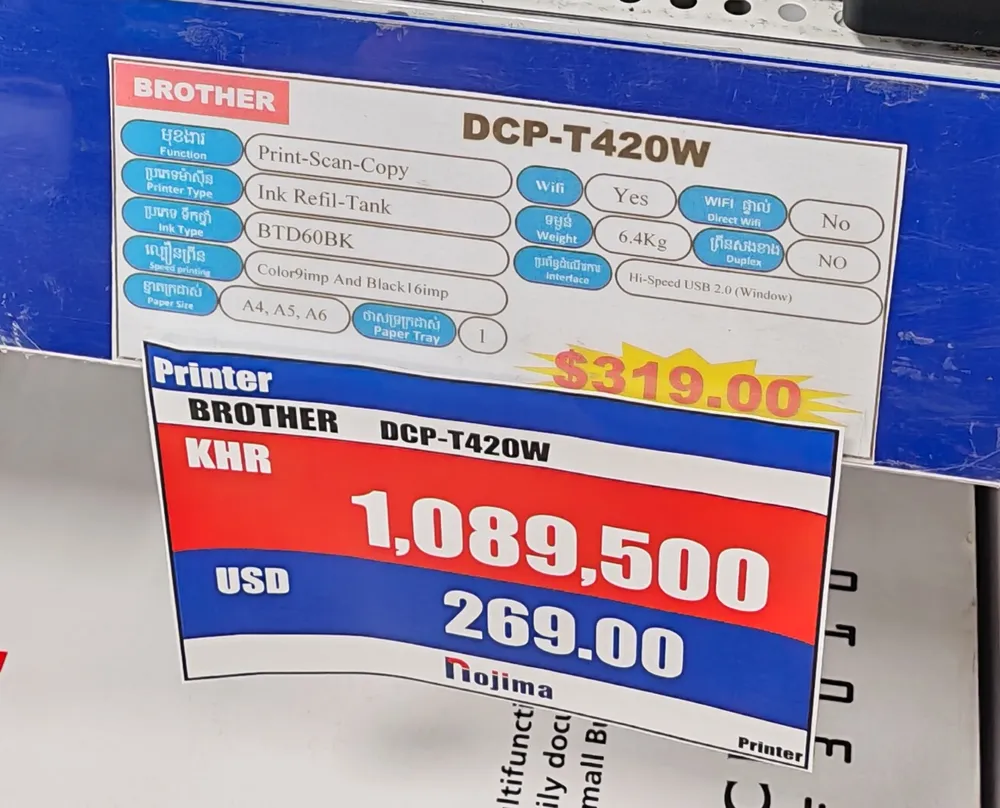
There are three prices in this photo:
$319.00on the white tag behind, the regular price;KHR 1,089,500on the red promotion tag;USD 269.00on the same promotion tag.
The red tag is the current price: 1,089,500 riel or $269.00. You can check that the two amounts on it belong together: 1,089,500 divided by 269 is about 4,050, close to the bank rate. The $319.00 on the white tag does not match the riel amount, which tells you it is the older price the promotion replaces. Other tags in the same shop followed the same pattern, for example KHR 1,251,500 / USD 309.00 over a white $349.00.
So when you see two dollar prices, look for the one that has a matching riel amount next to it. That is usually the price you will pay.
Per-kilo labels at the fruit counter
Supermarket electronic labels in the fresh section often show a price per kilogram, not a price per piece. This Makro label for durian gives 29,500 riel in large figures and 7.20 USD underneath:
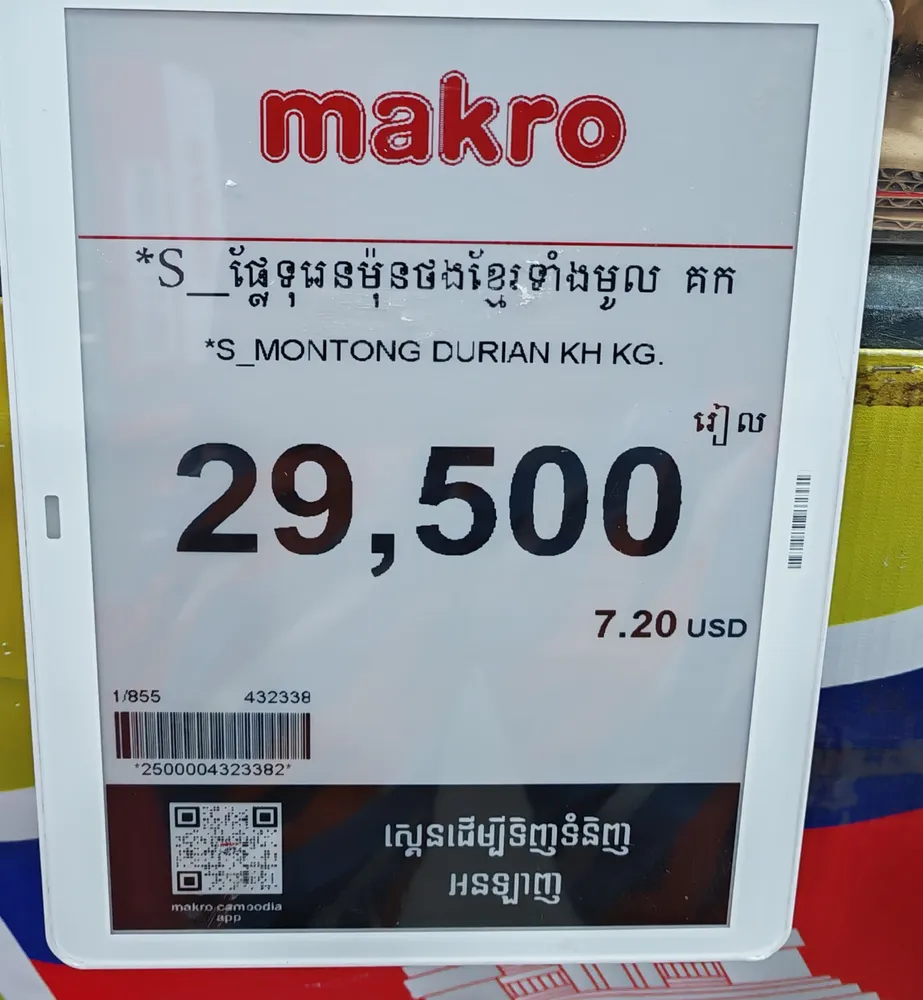
The clue is the KG at the end of the product name (MONTONG DURIAN KH KG.): the price is for one kilogram. A whole durian weighs more than that, so the amount you pay depends on the weight of the fruit you pick. Do not read 7.20 as the price of one fruit.
Whole-dollar prices without cents
Expensive items are sometimes priced in whole dollars without cents. This tag for a second-hand laptop simply says $1299, next to the Khmer word for price:
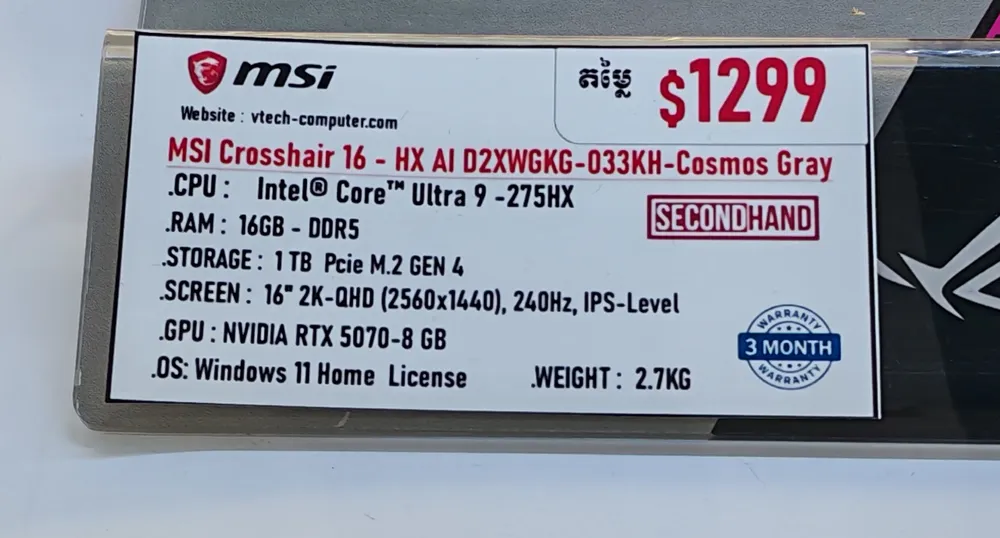
That is one thousand two hundred and ninety-nine dollars. On a laptop the size of the number makes it obvious, but on small items a price without a decimal point can be ambiguous: a faded or badly printed $150 could be $1.50. If a price looks far too high or too low for what it is, look closely for a decimal point, or ask.
A quick checklist
- One dollar price on the tag: that is the price.
- Riel and dollars side by side: the same price in two currencies.
- A coloured tag in riel and dollars over an older dollar price: pay the coloured tag's price, the one whose riel and dollar amounts match.
KGin the product name or a per-kilo sign: the price is per kilogram, not per item.- No cents: read it carefully, especially on cheap items.
How GlotLens helps
GlotLens reads Cambodian price tags through your phone's camera. It reads dollar prices ($, USD) and riel prices (KHR, ៛), and on a promotion tag that gives matching riel and dollar amounts it picks that dollar amount as the price to pay, over the regular price behind it. It does not give a confident price for a per-kilo label or when it is unsure; a dollar price without cents, like $1299, is listed for you to tap rather than taken automatically, unless you have turned on AI recognition. The price you confirm is converted into your own currency and can go straight into the expense ledger. Download GlotLens before your trip.