
Vietnamese supermarkets and convenience stores love multi-buy offers. Drinks, snacks, yoghurt and fruit often carry a bright card with "2+1", "Combo 2" or "Mua 2 tặng 1". The catch for a visitor is that the biggest or most eye-catching number on the card is not always the price of one item. This guide shows the common formats with real tags, and how to find the price you pay if you only want one.
The rule of thumb
Look at what follows each price:
- A price per one unit (đ/Hộp, /CHAI, /LON, /gói, đ/Lốc) is what one box, bottle, can, packet or multipack costs.
- A price for several is followed by a number or a bundle word: /3 CHAI, /COMBO, 2 HỘP, 3 Lon.
If you buy one, you pay the per-unit price. The price for several applies only when you take the full quantity to the till.
Combo 2: the bundle price is for two
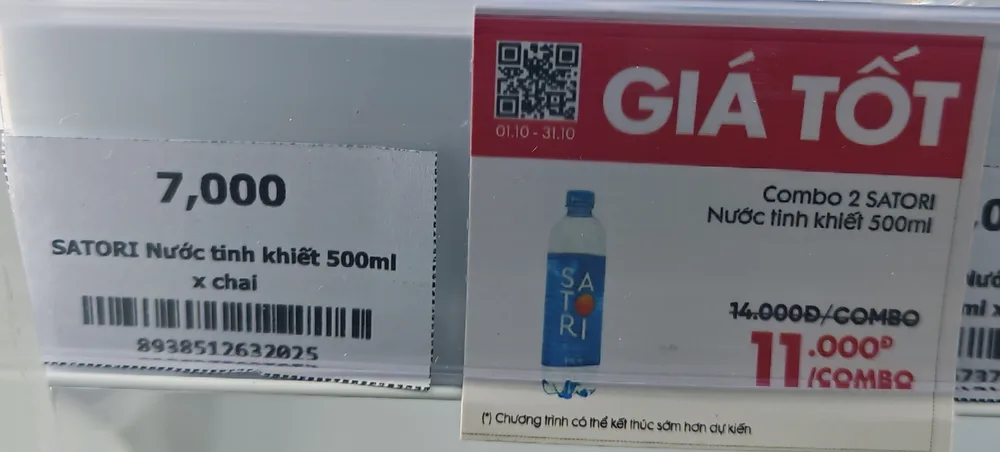
At GS25, a red GIÁ TỐT (good price) card offers Combo 2 SATORI water at 11.000đ/COMBO, down from 14.000đ per combo. "/COMBO" means the price is for the pair. The white shelf label next to it shows the single bottle: 7,000 per chai (bottle). Buy one bottle and you pay 7,000; buy two and you pay 11,000 for both, 5,500 each.
A variant at GS25 says "Chỉ thêm 1K" (only 1K more): a combo of two costs only a thousand dong more than one. On one such card, two packets of noodles were 14.000 per combo while the single-packet label beside it said 13,000.
2+1 and 3+1: the big number is per item
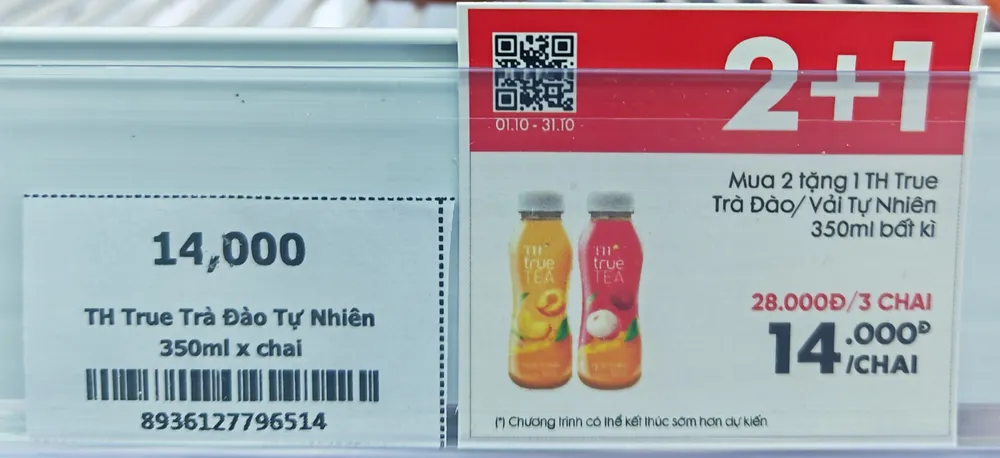
GS25's red 2+1 cards work the other way round. Mua 2 tặng 1 means buy two, get one free. The small red line 28.000Đ/3 CHAI is the price of all three bottles; the large 14.000đ/CHAI is the price of one bottle, which is also what the white shelf label says. If you take one bottle, you pay 14,000. Take three and you pay 28,000. "Bất kì" on the card means you can mix any of the listed flavours. Cards marked 3+1 (Mua 3 tặng 1, buy three get one free) follow the same pattern.
"Chỉ … 2 hộp": a price for two above the price for one
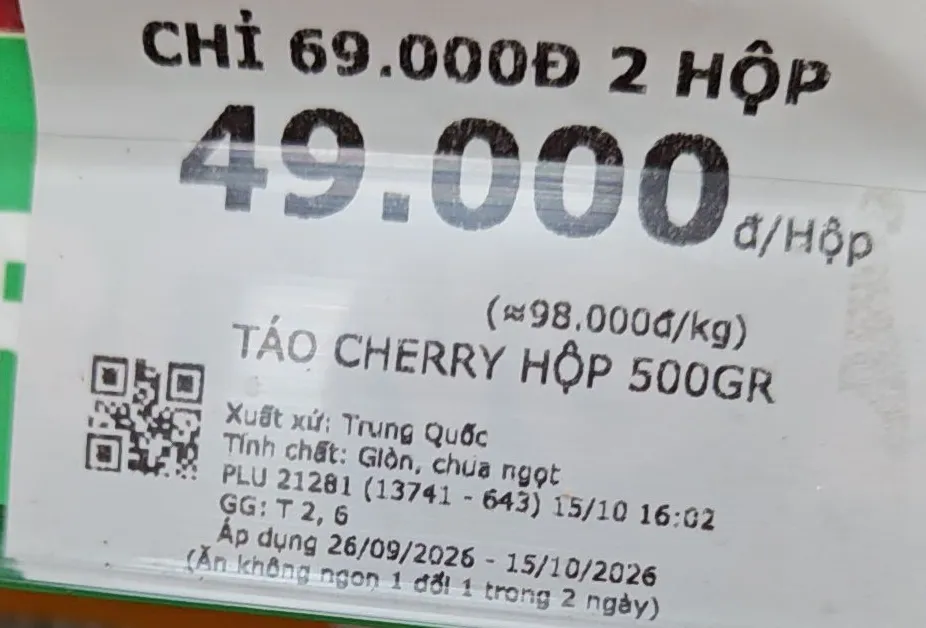
On this Bách Hóa Xanh tag the large 49.000 đ/Hộp is the price of one 500 g box of cherry apples. The line above it, CHỈ 69.000Đ 2 HỘP, means "only 69.000đ for 2 boxes". One box: 49,000. Two boxes: 69,000 together. The bracketed (≈98.000đ/kg) is only the per-kilogram comparison for one box.
Mua … tặng and mua … giảm
Other wordings you will meet on Bách Hóa Xanh tags:
- Mua 2 tặng 1; mua 5 tặng 3 vị bất kỳ above 24.500 đ/Lốc: buy 2 packs, get 1 free; buy 5, get 3 free, any flavour. One pack still costs 24.500.
- Mua 2 lốc giảm 5.000đ above 29.000 đ/Lốc: buy 2 packs and 5.000 dong comes off. One pack costs 29.000.
- Mua 3 giảm 6.000đ, mua 2 giảm 2.000đ with 34.000/lốc 4 and 160.000/thùng: the reductions depend on how many you take; 34.000 is one pack of four, 160.000 is a whole carton (thùng).
- (Mua thùng tiết kiệm …) in brackets under a per-packet price: buying the whole carton saves that amount. It is a note, not a price.
Convenience stores use the same words. At Circle K, cards saying MUA 2 TẶNG 1 / BUY 2 GET 1 FREE sat above the normal single-item label (17,000 VND for one packet of chicken feet). A Pepsi card offering MUA 3 … 39K 3 Lon charged the same as three single cans (13,000 VND each); the deal there is the free gift (TẶNG).
Sometimes "tặng" means a gift rather than another of the same product. GS25 cards such as "Mua 1 … tặng móc khóa" (buy 1, get a keychain) give a small gift with a single purchase; the price on the card is still the price of one.
Pack sizes are not multi-buys
A number of items right after the product name, or on a line of its own, is the pack size, not a condition: on a face mask tag, "5 cái" (5 pieces) after the name means the price is for one pack of five. But "2 cái 85.000đ", with the count directly in front of the price, is the price of two.
Check the dates
Promotion cards carry a validity period, such as 01.10 – 31.10 on GS25 cards or "Áp dụng 11/10/2026 - 19/10/2026" on Bách Hóa Xanh tags, and GS25 adds "Chương trình có thể kết thúc sớm hơn dự kiến" (the promotion may end earlier than planned). If the price at the till is different, check the dates first. For the other words on these cards see the price tag glossary, and for dong amounts see how to read prices in Vietnam.
How GlotLens handles multi-buy tags
GlotLens recognises multi-buy wording in the Vietnamese text (mua 2 tặng 1, 2+1, combo, prices per 3 chai or for 2 hộp) and never treats a combo or multi-buy price as the price of one item. A per-item price that only holds when you buy enough, such as "Mua 2 hộp giá 40.000đ/hộp", is not taken as the single price either. When the tag gives no clear single-item price, GlotLens does not invent one: it asks you to check the tag and lets you tap the price you will pay, then converts it into your currency. Download GlotLens.