
Vietnamese prices look alarming the first time you see them: 38.000 for a box of eggs, 29.490.000 for a dryer. Nothing is wrong with your eyes. The Vietnamese dong is a currency of large numbers, and once you know how the zeros are written, every tag in the country reads the same way.
The dot is a thousands separator, not a decimal point
On most Vietnamese tags the dot groups thousands. 38.000 is thirty-eight thousand dong, not thirty-eight. There are no cents: the dong has no smaller unit, so you will never see a real price with two decimals after it.
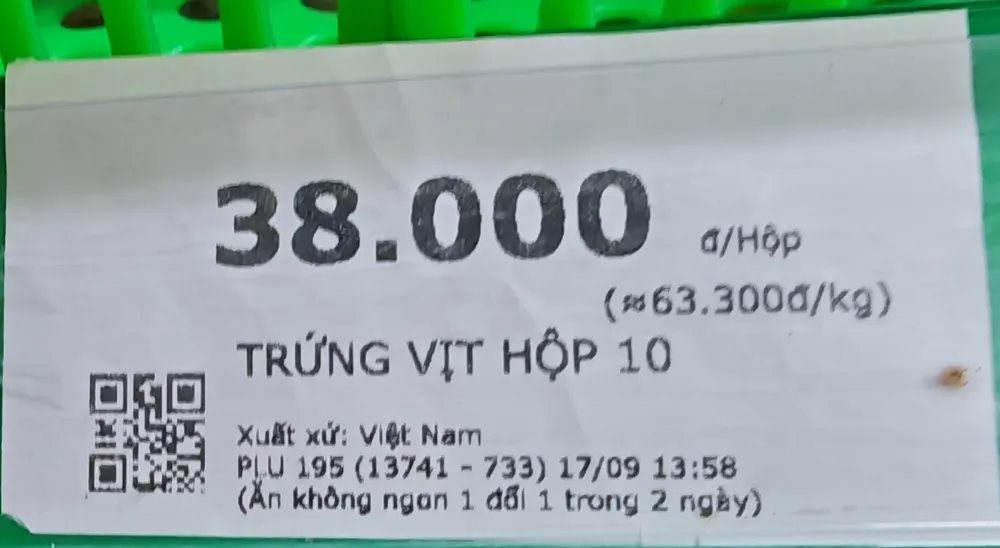
This shelf tag from Bách Hóa Xanh shows the usual layout:
- 38.000 in large print is the price.
- đ/Hộp says the currency (đ, dong) and what the price is for (hộp, one box).
- (≈63.300đ/kg) in brackets is only a comparison: the same eggs worked out per kilogram. You pay 38.000 for the box.
Commas, VND, VNĐ, đ and ₫ all mean the same
Not every shop follows the dot rule. Circle K, GS25's white shelf labels and some cards at AEON and Annam Gourmet group thousands with a comma: 13,000 VND, 7,000, 81,576 VNĐ. It is still thirteen thousand, seven thousand and about eighty-one thousand dong. Because dong prices never have decimals, a comma or a dot followed by exactly three digits is always a thousands separator.
The currency can be written in several ways, sometimes on the same shelf:
- đ or Đ (the Vietnamese letter for dong), often right after the number or raised above it
- ₫ (the currency sign)
- VND or VNĐ
- nothing at all, especially on convenience store shelf labels
Some tags print the thousands part smaller and raised: a big 149 followed by a small .000đ at Kingfoodmart, or 18.000 with the .000 raised on a GS25 promotion card. Read it as one number: 149.000 dong.
"K" means thousand
On posters, hangers and promotion cards you will often see K: 39K, 55K, "Chỉ thêm 1K" (only 1K more). K stands for thousand, so 39K is 39.000 dong.
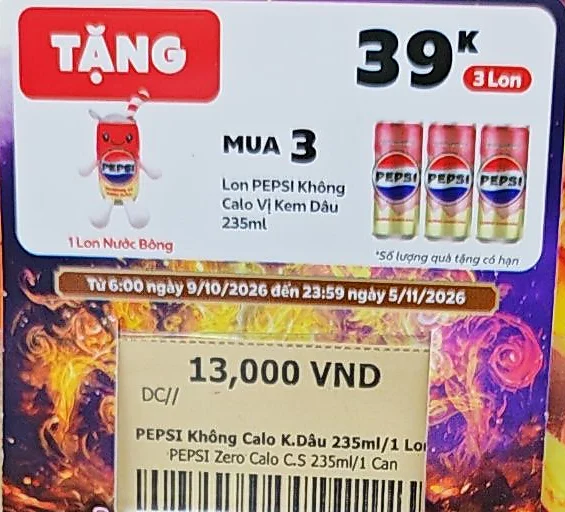
This Circle K hanger uses both styles at once. The shelf label in the middle says 13,000 VND for one 235 ml can. The card above says MUA 3 (buy 3) for 39K / 3 Lon (39.000 for three cans) and TẶNG (free gift) one more drink. Three cans at 13,000 each is exactly 39,000, so the card is advertising the gift, not a lower can price. More on reading cards like this in buy-two deals on Vietnamese price tags.
Millions on electronics
Furniture, appliances and electronics run into millions, written with two separators.
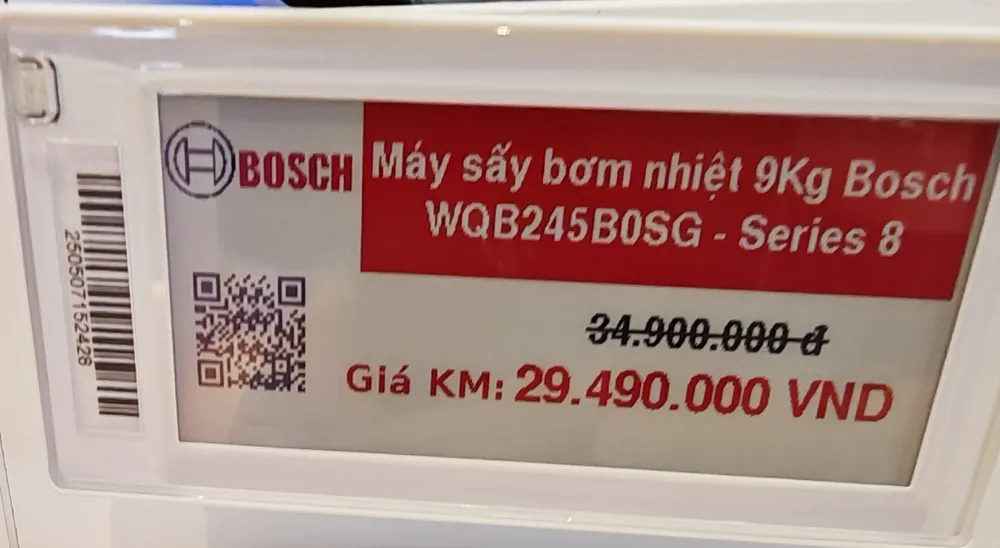
On this AEON electronic shelf label, 34.900.000 đ is crossed out and Giá KM: 29.490.000 VND is the promotion price (KM is short for khuyến mãi, promotion). That is twenty-nine million, four hundred and ninety thousand dong. In speech, and on some signs, a million is called triệu and a billion tỷ, but the tags in our photos wrote every price out in full.
Note the "9Kg" in the product name: it is the dryer's load, not a price per kilogram. Only the unit right after the price (đ/Hộp, đ/Kg, /CHAI) says what the price is for.
A few things that are not prices
- Bracketed amounts with ≈ (a per-kg or per-unit comparison).
- Long numbers under the price: barcodes, product codes and print times such as "PLU 195 (13741 - 733) 17/09 13:58".
- Dates such as "Áp dụng 11/10/2026 - 19/10/2026" (valid from–to) on promotion tags.
- Placeholder prices like 888.888 on an empty shelf slot. Lucky numbers such as 8.888 or 88.888 are, however, real prices.
An amount below 1.000 dong on a supermarket tag is almost certainly a misread or a different number.
How to convert dong in your head
Start by ignoring the last three zeros and thinking in thousands: 38.000 is "38 thousand", 149.000 is "149 thousand", 29.490.000 is "29,490 thousand". Then use one memorised reference amount, for example what 100.000 dong is worth in your currency, and scale from there. The current rate and a table of common amounts are on the dong to US dollar converter; there are also pages for euros, Chinese yuan, Korean won, Japanese yen and roubles.
The number is usually the easy part. The words around it decide whether that number is what you pay: see the price tag glossary, and the guides to member prices and weighed goods.
Let GlotLens read the tag for you
Point GlotLens at a Vietnamese price tag and it reads the amount, translates the product name and shows the price converted into your own currency. When it cannot tell which number on the tag is the one you pay, it does not guess: it asks you to check the tag. Download GlotLens before your trip.