
Fruit, vegetables, meat, cheese and deli food in Vietnamese supermarkets are often sold by weight. That means two kinds of price: a price per kilogram (or per 100 grams) on the shelf, and the actual amount for your pack printed on a sticker. Mixing them up is the most common way to misjudge a price by several times. Here is how to tell them apart on real tags.
Shelf tags with đ/Kg: a price per kilogram, not per item
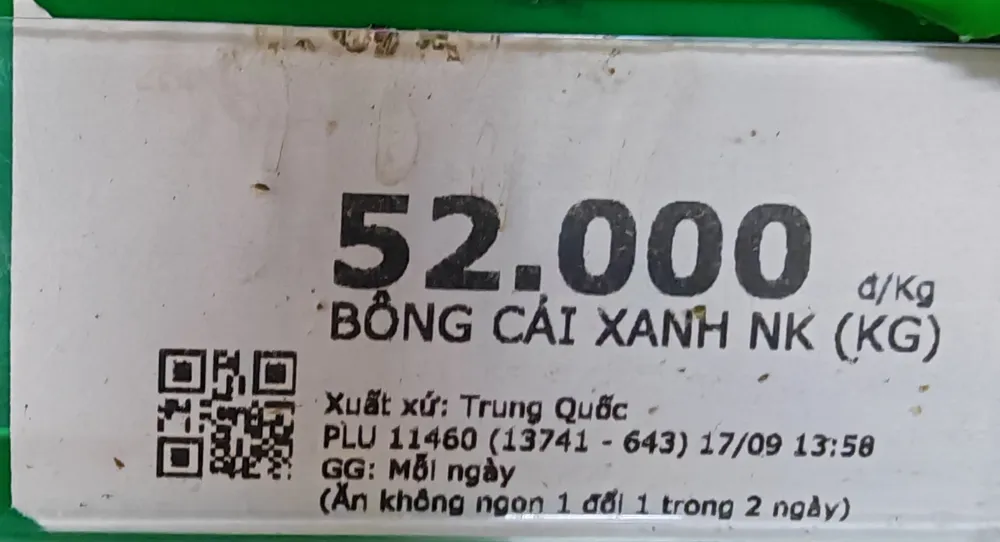
On this Bách Hóa Xanh tag, 52.000 đ/Kg is the price of one kilogram of imported broccoli, and the name itself ends in (KG). It is not the price of one head. You pay 52.000 multiplied by the weight you take: half a kilo costs about 26.000. Loose tomatoes, limes, cassava, oranges and grapes at the same chain had tags like this, from 13.000 to 89.000 đ/Kg, and none of them shows the price of a single piece.
The receipt shows what you paid: weighed items appear as a line with the weight, such as 0,75 kg (Vietnamese uses a comma for decimals in weights).
Packs with a bracketed per-kg price: pay the pack price
Not every tag that mentions kilograms is a per-kg price. A Bách Hóa Xanh tag reading 38.000 đ/Hộp (≈63.300đ/kg) is the price of one box; the bracket with ≈ is only a comparison to help you judge value. The same goes for 24.300 đ/túi (≈121.500đ/kg) for a 200 g bag of garlic and 9.000/trái (≈25.700/kg) for a single corn cob. The unit right after the big price (Hộp, túi, trái) tells you what you are paying for.
Weights in the product name are just the pack size: "TÁO CHERRY HỘP 500GR" is a 500 g box, and "9Kg" on a dryer's label is its load.
Weighed stickers: the total is what you pay
Pre-packed fruit, meat and deli trays carry a printed sticker from the store's scale with three numbers: the unit price, the weight and the total.
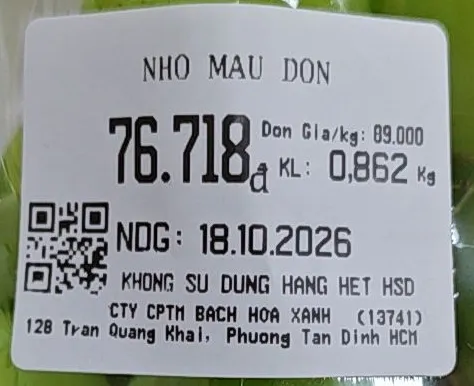
On this Bách Hóa Xanh sticker:
- Don Gia/kg: 89.000 (đơn giá) is the price per kilogram.
- KL: 0,862 Kg (khối lượng) is the weight of this pack.
- 76.718đ, the largest number, is the total for the pack: 89.000 × 0.862 = 76.718.
You pay the total, 76.718 dong. Odd, non-round totals like this are normal on weighed goods and are not a misprint.
Other shops use different layouts with the same three parts:
- At Annam Gourmet a rambutan sticker read KL: 824 g, 81,576 VNĐ and Don gia: 99,000 /kg. Total: 81,576 (99,000 × 0.824).
- A Co.op Xtra sticker for dried jujubes had the columns DonGia (đơn giá), KhoiLuongTinh (khối lượng tịnh, net weight) and Thanh tien (thành tiền, amount): 252.000đ, 350 g, 88.200. Total: 88.200.
- AEON deli trays show only the total, Giá (VND): 42.336, with the weight as KLT/QTY: 144 g. A separate round "giảm giá 30% off" sticker on the lid had no price of its own.
The quick check is always the same: unit price × weight = total. The number that matches that sum is the one you pay; the number next to "đơn giá" or "/kg" is not.
Per 100 grams for premium fruit, cheese and deli
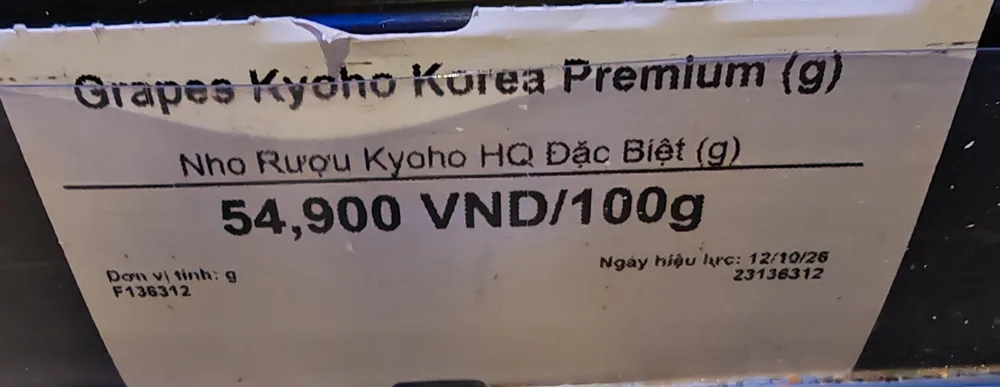
Premium fruit, cheese, cold cuts or seafood may be priced per 100 grams instead of per kilogram. At Annam Gourmet the Korean Kyoho grapes above are 54,900 VND/100g, and the cheese cards read 98,000 VND/100g and 189,000 VND/100g. That is ten times less than the price per kilogram would be, and still not the price of what you buy: a 500 g box of these grapes would be about 274,500 dong. Ask for the weight you want and check the sticker on the wrapped piece, which shows the total.
Summary
| On the tag | What it is | Do you pay it? |
|---|---|---|
| 52.000 đ/Kg | price per kilogram | No, multiplied by the weight |
| 54,900 VND/100g | price per 100 g | No, multiplied by the weight |
| 38.000 đ/Hộp (≈63.300đ/kg) | box price with a per-kg comparison | Yes, the 38.000 |
| Đơn giá 89.000, KL 0,862, 76.718đ | weighed pack | Yes, the 76.718 |
For more tag words see the price tag glossary, and for reading dong amounts see how to read prices in Vietnam.
How GlotLens handles weighed goods
GlotLens knows the difference. On a shelf tag for loose produce, such as a name ending in "kg" with a đ/Kg price, it treats the number as a price per kilogram and does not present it as the price of an item. On a weighed sticker, it takes the amount printed with the weight as the price of the pack, even when "Đơn giá" is printed nearby, and converts that total into your currency. When it is not sure which number is the total, it asks you to check the sticker rather than showing a wrong price. Download GlotLens.